
Acquavena Organics
About Our Process
From Philosophy to Finished Bar
It Begins With a Belief
Before any formula. Before any ingredient is sourced or any batch is made. There is a belief — and the belief is simple, even if honouring it is not.
The botanical world, approached with knowledge and respect, provides what living things need.
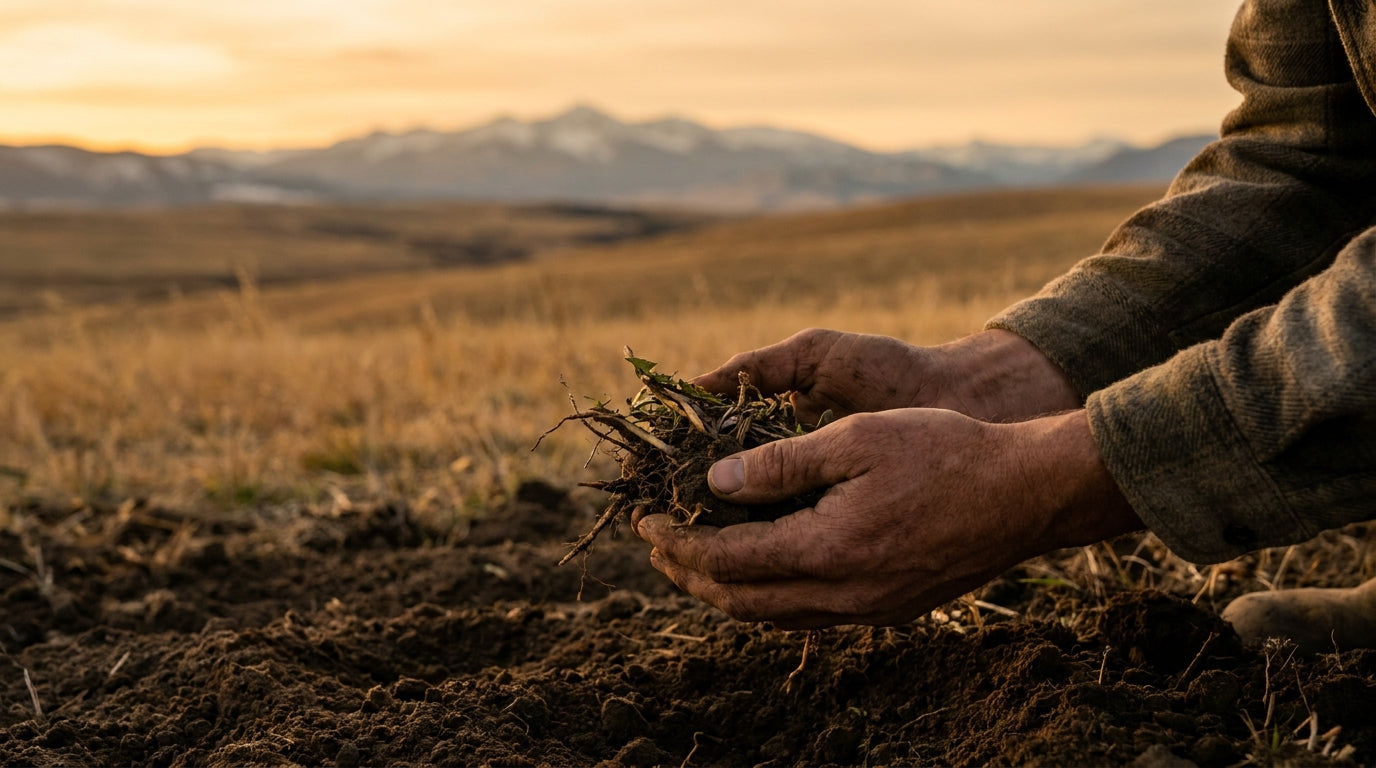
That belief came to Acquavena Organics directly from Rosina Quadracci — born in the village of Acquavena, in southern Italy — a woman who spent her life in close, practical relationship with the land. She did not need vocabulary for what she knew. She read the soil, the season, the specific plant, and exactly when it was ready. The intimacy she had with her botanical world is the standard we are always working toward, in whatever form is possible on a 30-acre estate at the base of the Rocky Mountain foothills.
What this belief requires, in practice, is that every formulation decision — what goes in, what stays out, what concentration, what source — is answerable to a single question: does this ingredient have a genuine botanical reason to exist in this formula? Does it earn its place?
Asking that question consistently — and accepting the answers when they are inconvenient, which they often are — is what makes formulation at Acquavena slower, more deliberate, and more uncertain than it would be by conventional industry standards. It is also what makes it meaningful.
Every Product Begins With a Problem
Not a formula. Not a trend. A genuine, specific, observed problem — a skin concern the market is addressing badly or dishonestly, a botanical compound that the science points toward but that no formulator is using well, a gap between what exists in nature and what exists on the shelf.
The concept phase is the most intellectually alive part of the work. We read clinical studies, traditional texts, ethnobotanical traditions. We hold competing ideas simultaneously and let them work on each other until something clarifies. Some concepts never leave this phase — an idea that seemed compelling reveals itself, under sustained scrutiny, to be a trend rather than a need, or the botanical science does not support the effect with enough rigour.
The concepts that survive can answer three questions without equivocation: What specific problem does this product solve, and for whom? What botanical evidence supports the solution? And is there an honest place for this product in the market that does not already exist?
If all three can be answered clearly, formulation begins.
Sourcing: Where Values Either Live or Die
Sourcing is almost entirely invisible to the person holding the finished product. It is also where everything that matters is decided.
Certified Organic
We prioritise suppliers with verifiable organic certification — not because certification is everything, but because it establishes a floor of practice and tells us specific things about how the ingredient was produced.
Long-Term Land Relationships
We look for suppliers with long-term relationships with the land they work, because sustainable botanical sourcing requires something closer to stewardship than extraction.
Reformulate, Not Compromise
There have been ingredients we wanted to use that we could not source to our standards at a commercially viable cost. In those cases, we reformulate rather than compromise on where they come from.
Where a botanical ingredient comes from determines its performance in a fundamental way. The phytochemical profile of a plant — the actual concentration and ratio of its bioactive compounds — is shaped by the soil it grew in, the climate it experienced, the timing of its harvest, the method of extraction, and the conditions of processing and storage.
Two products both labelled with the same ingredient name can contain materially different compounds depending on every step of that chain. The label says the same thing. The effect on skin is different.
We ask our sourcing partners questions that most buyers do not ask.
Most soap begins with water.
Ours begins with botanicals.
The Making: A Small-Batch Method With Nothing Hurried
Every Acquavena cleansing bar is made by hand, in small batches, using a hot-process method refined specifically to preserve the integrity of botanical actives from first step to finished bar.
Oil & Butter Base
Organic shea butter, organic coconut oil, organic and sustainably sourced palm fruit oil, organic cocoa butter, and organic jojoba are gently combined under low heat until unified — each one chosen for a specific contribution to skin nourishment and lather quality.
Botanical Hydrosol Lye Solution
Rather than using plain water, we use a trio of botanical hydrosols — green tea, dandelion root, and burdock root — infusing the very foundation of the soap with gentle antioxidant and purifying plant intelligence before a single extract has been added.
Combined to Medium Trace
The combined oils and botanical lye water are gently mixed to medium trace — the point at which the emulsion is stable and ready for the next phase.
Hot Process: One Hour in the Oven
The batch is transferred to a low oven for one hour. This is the hot process — where saponification completes fully in a single controlled session, so that by the time the soap leaves the oven, no lye remains. The result is a bar that is immediately gentle, without the extended alkalinity of cold-process soaps.
Superfat with Rosehip Oil at 40°C
Once cooled to 40°C, we superfat with rosehip oil. The timing is intentional: rosehip is rich in delicate polyunsaturated fatty acids and bioactive compounds that do not survive saponification. By adding it after the chemistry is complete, we ensure every bar carries rosehip's full skin-renewing benefit, unaltered.
Botanical Extracts & Collection-Specific Ingredient
A concentrated boost of dandelion root, burdock root, and green tea extracts is blended in. Depending on which bar is being made, one additional extract is introduced: sea buckthorn, chamomile, calendula, or kaolin clay. Each addition is specific to that bar's formulation purpose. Nothing here is decorative.
Hand-Pressed into Molds
The finished batch is hand-pressed into small-batch molds and left to cool and set for 24 hours.
Hand-Cut & Hand-Finished
Every bar is hand-cut — a step that allows us to assess the batch, not simply process it. Each bar is then hand-finished: edges and corners smoothed by hand before being set upon cedar boards.
Cedar Board Cure: Two to Four Weeks
Cedar is naturally antimicrobial and breathable — it draws moisture away from the curing bar at a consistent rate. The cure is where the soap's character fully develops: lather quality, hardness, longevity, and the way the botanical compounds settle and stabilise. We do not shorten this period. Two to four weeks is what the bar requires.
Failure in formulation is not the opposite of quality.
It is the process by which quality is found.
On Failure
The process described above represents what the work looks like when it is going well. We want to be honest about the rest.
There are Acquavena formulas you will never see. Batches that revealed a stability issue only visible in extended real-world testing. An iteration that was very good — genuinely well-received — that we nonetheless set aside because we could identify what 'right' looked like, and very good was not it. The willingness to say that, repeatedly, and to go back — not around a problem, but back to the formula — is what the process demands.
Rosina never presented her botanical knowledge as infallible. She adjusted, returned, tried again. She read the land and when the land told her something was not working, she listened.
That is the practice we are trying to honour.
What You Hold
Every Acquavena Organics cleansing bar carries all of this — all of the time, the thought, the sourcing decisions, the failures, the refusals to stop before the thing is done properly — in a way you cannot see on the label.
But now you know it is there.
We hope that changes, even slightly, how it feels in your hands.
Go Deeper — ROOTED, Season 1
Behind the Formula: How a Botanical Skincare Product Actually Gets Made
Jeff Lindh takes you further behind the formula than this page can — the philosophy that precedes the product, the failures that shaped the formulas that survived them, and the sourcing decisions that most of the industry would rather leave in comfortable vagueness.
Listen on Apple Podcasts